
Petrol Dog
100 Dogs of India Project - Day 96

The First Four Hours.
For our most recent visit to India we decided to leave home as soon as possible after Christmas and arrive in Mumbai in time for New Year’s Eve. We had quite a journey to complete before we even left our own country, with multiple family Christmas visits, dog depositing and long stretches of driving until we finally reached Heathrow Airport in London. We flew through the night from London and arrived at some awful hour in the morning in Mumbai airport, at almost exactly our bed time back home.
Our arrival experience was exactly how we expected it to have been, having flown many times in and out of another enormous Indian airport, Delhi. Ponderous, tiring, confusing and chaotic. Despite arriving with all the correct digital clearances, our E-Visa and our E-Landing Card, we touched down at Chhatrapati Shivaji Maharaj International Airport and almost immediately hit a snag.
As we walked through the terminal corridors filled with the warm and strangely scented air that lets you know you’re in a different country, following the signs for arrivals, we were guided to a selection of self-service kiosks scattered randomly in an alcove. Signs told us quite clearly that these Digi-Yatra facial-recognition machines were the future and that using this new system was highly recommended. What was less encouraging was that several of them were switched off already, and all the others were being used by fellow travellers who looked as though they were ready to give up on India entirely and return to the plane before their trip had begun. I should add, we had tried to use these Digi-Yatra machines before as we were leaving another Indian airport. That attempt resulted in me being held inside the terminal building which gave me a great view, through the albeit very dirty glass facade, of Fiona being denied entry and being held outside the terminal.
Back in Mumbai, not wanting to continue past these machines for the very real fear of being told later that we have to come back and use them anyway, we decided to have a go at one that had recently been vacated by a very angry Italian lady who had made no progress whatsoever and was ready to collapse in a heap of sweaty frustration. I don’t know what she was saying but it didn’t sound like she was having the best morning. I tried to input my details and was rejected several times for various reasons. Fiona, on the other hand, typed in her information and was accepted first time, much to the bemusement of every other person there, myself included. My top travel tip — ignore those machines. They are utterly pointless, like much of the E-Bureaucracy in India. Despite Fiona being the one to be successfully digitised, it actually took her much longer than me to be processed by the analog human later on.
We joined a very long serpentine queue in passport control and patiently waited for 90 minutes with everyone else. Like something from a futuristic dystopian horror story, the arrivals hall was truly vast and lined with a very long row of passport booths and their associated confusing signs. What it wasn’t full of, sadly, were any staff. There seemed to be just two or three people processing plane after plane of arriving tourists, and the only way you could survive the mental and physical torture was by shuffling slowly forward in a half-awake state (it was now well after our bed time) and chatting to our new queue neighbours.
Once we were past immigration, it felt as though the whole of India was almost within our grasp. First, however, we had to get to our hotel some 45 minutes away by car. My phone was playing up (great timing as usual) so our usual go-to Uber was out of the question as we couldn’t use the app. The next best option, we thought, would be the government-approved taxis. Just as the sign said, they would be safe, inexpensive and all the drivers were female (this seemed to be a big thing in Mumbai, but nowhere else).
We paid our reasonable fare and received our instruction to pop outside into a weirdly empty part of the airport road system where we would find our waiting chariot. The first taxi we laid eyes upon was comically bad and looked like it had been rescued from a scrap yard some years earlier. We were initially relieved that this was not our car. And then we quickly wished it was. Our lady driver jumped up from her broken white plastic garden chair, took some time to carefully pull a loose part of her sari over her head, and led us to a car that looked like it too had been rescued from a scrap yard, only after it had been crushed and left in the rain for 15 years. I kid you not — not one single part of this car looked useable. However, it was literally the only one we could choose so we did what you must learn to do in India and simply embraced the experience.
As with most taxis in India, the majority of the luggage space in the boot was filled with a huge cylinder of compressed natural gas. So, after wedging our two backpacks into the front passenger seat, being sure that the driver still had enough room to actually move the gear lever, we squeezed into the rear seat, discovered that seatbelts weren’t one of the options the original owner specified for this car, and passed the lady the receipt given to us by the person at the desk in the airport. On the receipt was the address of our hotel.
I told her where we were going, she did the indecipherable Indian head-wobble to acknowledge what I’d said, and drove us, very slowly, into the night. In the wrong direction. My phone had now decided to connect itself with the Indian 4G system and I had Google Maps up and running with our hotel set as the destination, some 46 minutes away. After managing to coax her onto the road that Google suggested, we drove for some time, continually making unnecessary changes to the route on an otherwise completely empty road (it was 5 in the morning by now). Ten minutes later our destination was still 46 minutes away.
I asked her why she kept changing routes and she replied that it was because the suspension on the car was broken and that her preferred route was smoother. Her route was definitely interesting. There is something ethereal about driving at night in a country so very different from your own. Although all I wanted was to get to my bed I couldn’t help but be fascinated by the enormous and hideous tower blocks lining the road, interspersed with super-fancy ones complete with fountains and gardens. The incredibly dim single headlight of our car picked out a girl wearing gym gear who was out for a run in the absolute darkness on what would be a motorway here. Small huddles of people sat around glowing fires all along the roadside and police at checkpoints stood still, doing nothing. A man coaxed a small group of cattle along the side of the street. Where he had come from, and where he was going, I have no idea but central Mumbai did not seem to be a good place for a cow. This couldn’t have been more different from our home in Scotland.
Despite the less than ideal driving conditions our driver still had a wee go at extorting a little extra cash by telling us that the Sea Link road was much faster, but would cost an extra 100 Rupees because of a toll, perhaps not knowing that her boss in the airport had already made it clear that there would never be any extra charges. We told her we weren’t paying her a penny more and she went that way anyway, perhaps becoming the slowest vehicle ever to drive on the new coastal expressway.
After 75 minutes of motoring we were nearing the end of our 46 minute trip. However the driver still didn’t know where she was going and we got lost in the last kilometre. Perhaps the constant faint smell of gas in the car had addled her brain. Our hotel was almost next door to the very famous and iconic India Gate, but she didn’t know where that was either. That’s like a London taxi driver not knowing where Big Ben is. For several more minutes we sat in her battered wreck of a car. I was leaning forward between the front seats, holding my phone up for her like a human sat-nav with my right hand, whilst using my other to prevent the poor lady from being crushed under 30kg of collapsing backpacks every time she turned left.
Eventually we arrived at the Abode Mumbai - our lovely hotel. Stepping out of the car into Colaba at almost 6AM in the morning, sending a couple of huge rats scurrying off into a corner was an immense relief and it felt that the holiday could finally start. We tried not to disturb the snoozing dog, curled up on the top step as tightly as a bowling ball, as we snuck past with our luggage before being given a very lovely warm welcome by the night manager and shown to our beds. Interestingly that dog was never again on the step and I regretted not making a photograph of it that first night.
We had been in India for an exhausting four hours and already we’d had a great adventure. That’s what I love about being there. Things can be an ordeal at the time they are happening, but each experience makes you into a more rounded person and a more robust traveller.
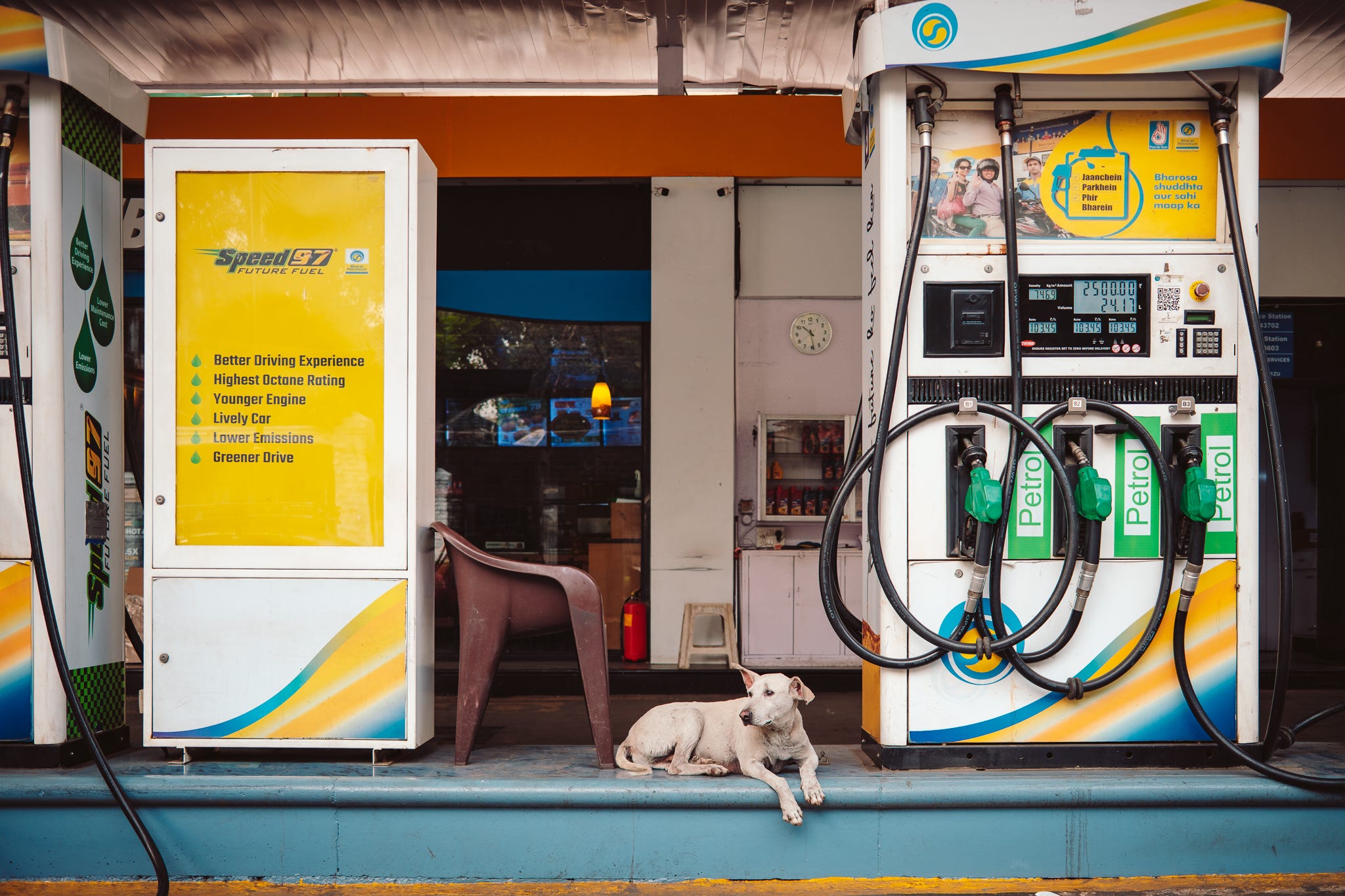
I don’t make a habit of offering practical travel advice but I would say that Uber is actually really good for getting around India. If you have a mobile phone with access to their app (I use an AloSIM e-SIM, which I purchase before leaving home) it makes travel a breeze. Cheap and reliable it saves a lot of hassle. We even took to splashing out on the fancier Uber Black — still much cheaper than at home but I really appreciate that you can ask them to drive slowly and carefully and, if you want, even turn on the A/C. Uber even sent us a message to check we were OK because we had been stationary for a long time, but we were actually just filling up with gas at a service station where I made the photograph above.
I loved reading this. Every arrival experience in Bombay is TERRIBLE!! I hope you had the lovely Abode breakfast, a good nap and then headed out for vada pav and chai at Aram opposite CST. This is my ritual.